


The Executive Summary
Corporations have poured billions into Generative AI (GenAI). Now, the bill is due. By early 2026, the “analysis for did AI deliver financial returns for business” has shifted from theoretical optimism to hard accounting. The verdict is messy. While tech giants ride high on stock speculation, the rest of the market—retail, banking, logistics—faces a complicated reality. The “return” is rarely a direct spike in revenue. Instead, it appears as “soft” efficiency gains that are notoriously difficult to monetize, contrasted against “hard” returns that only materialize when AI successfully displaces human labor.
From FOMO to Fiscal Responsibility
Late 2022 changed everything. ChatGPT dropped, and the corporate world panicked. Nobody wanted to be the dinosaur left behind. By 2024, global spending on AI infrastructure smashed the $1 trillion mark.
But the honeymoon is over. It’s 2026. The “arms race” mentality is dead; now, it’s about accountability.
Shareholders and CFOs are done with vague promises of “digital transformation.” They want receipts. They are demanding a rigorous AI ROI Analysis—a calculation that weighs net financial gain against the staggering costs of implementation, cloud compute fees, and enterprise licensing. The question isn’t about innovation anymore. It is brutal and simple: Does the efficiency gained justify the premium price tag?
The “Productivity Paradox” and the Skeptics
You can’t discuss AI profits without acknowledging the skepticism that defined the mid-2020s. Goldman Sachs dropped a bomb in June 2024 with their report, “Gen AI: Too Much Spend, Too Little Benefit?”
Jim Covello, their Head of Global Equity Research, didn’t mince words. He argued that for a trillion-dollar infrastructure to be worth it, it must solve complex problems. Early GenAI? It was mostly summarizing emails and writing bad poetry.
This disconnect birthed the modern framework for analyzing AI returns. Analysts now hunt for the “Productivity Paradox”—a situation where tech investment skyrockets, yet output per hour flatlines. Why? Because employees were spending hours prompting, fixing, and babysitting the very tools meant to save them time.
2025 Data: The Reality Check
Then came the data. By 2025, vague projections from Deloitte and Google Cloud turned into hard numbers. The analysis moved from skepticism to evidence.
The results revealed a “K-shaped” split. Companies relying on basic text generation stalled. But those deploying “Agentic AI”—systems that do things rather than just say things—started seeing green, specifically in software engineering and support.
Table 1: The Evolution of AI Financial Metrics (2024 vs. 2026)
| Metric | 2024 “Hype Phase” Analysis | 2026 “ROI Phase” Analysis |
|---|---|---|
| Primary KPI | Adoption Rate (% of employees using AI) | Cost-Per-Task Reduction |
| Revenue Focus | Projected future growth | Attributable net income |
| Cost Consideration | License fees (e.g., $30/user/month) | Total Cost of Ownership (Token costs + Energy + Rework) |
| Success Indicator | “We launched an AI bot” | “We reduced support ticket cost by 25%” |
| Time to Value | Expected immediately | Understood to be 12-18 months |
The Hidden Costs in the Equation

Most ROI calculations fail because they are too shallow. They look at the software subscription and stop there. That’s a mistake. Modern analysis digs into the invisible margin-killers.
Token Consumption and Compute Every query costs money. One employee asking ChatGPT a question is cheap. Ten thousand employees doing it daily? That bill balloons. “Inference costs” are the silent budget killer for the enterprise.
The “Rework” Tax This is the single biggest drag on financial returns. If an AI writes a brief in 10 seconds, but a manager spends 45 minutes fact-checking hallucinations and rewriting the syntax, the financial return is negative. You haven’t saved money; you’ve just shifted the labor from “creation” to “correction.”
Where the Money Actually Is: Specific Use Cases
It’s not all doom and gloom. The math actually works in specific, high-friction areas. 2025 data highlights two clear winners:
1. Software Development The undisputed champion. AI coding assistants (like GitHub Copilot) cut boilerplate coding time by nearly half. Developer time is expensive. Saving 50% of it is direct, tangible profit. Products ship faster. Revenue arrives sooner.
2. Customer Service Automation We aren’t talking about dumb chatbots anymore. We mean “Agentic” support that resolves issues without a human ever touching the keyboard. Unlike creative work, where quality is subjective, a resolved ticket has a fixed price tag. If the AI handles it, you keep that cash.
Forward Outlook: The Agentic Shift
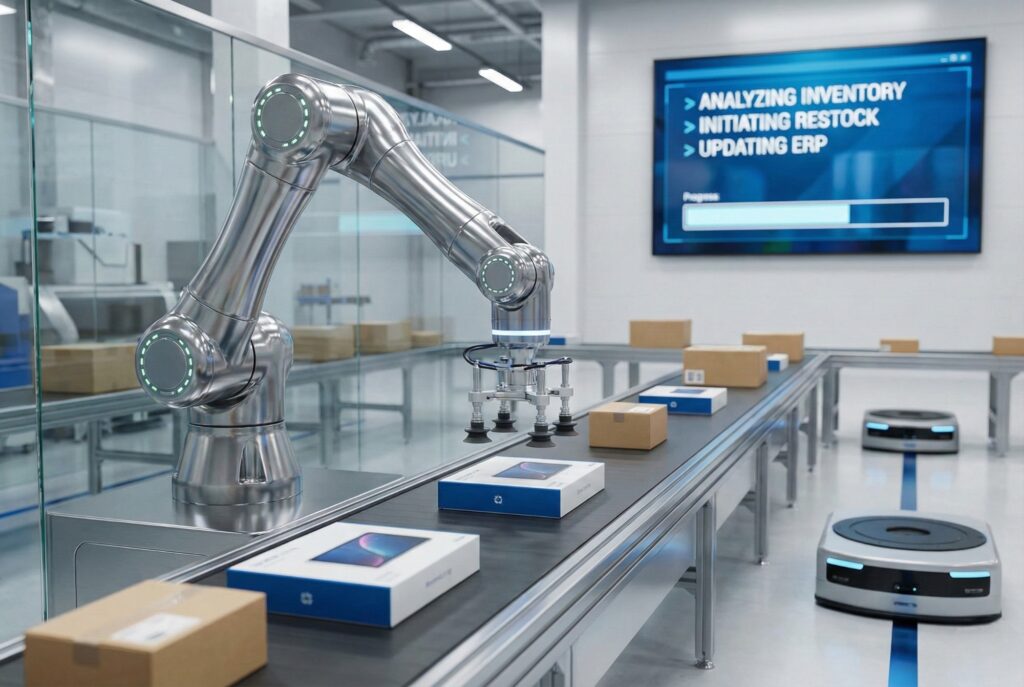
As we push through 2026, the goalposts are moving. The focus is now Agentic AI—autonomous systems that plan and execute. Think less “write an email” and more “analyze inventory, restock low items, and update the ledger.”
The math changes here, too. We are no longer counting minutes saved. We are calculating “Full Time Equivalent” (FTE) displacement. If an agent does the work of three junior analysts, the ROI is their salaries minus the compute cost. It’s a cold calculation. But it’s the only one CFOs care about right now.
AI isn’t a magic money printer. It is a heavy, expensive power tool. It only pays off if you point it at the right problem.
Does your organization have a framework to measure AI’s impact on net income? Start by auditing your “rework” time—the hours employees spend fixing AI output—to get a true picture of your ROI.
