

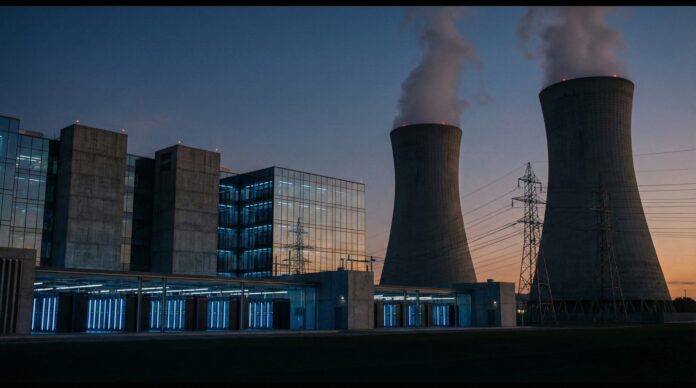
The internet is hitting a physical wall. For two decades, Silicon Valley ran on a mix of grid power and renewable energy credits. That era is over.
Faced with the staggering energy cost of artificial intelligence and rigid 2030 decarbonization deadlines, Amazon, Google, and Microsoft are abandoning the “solar-plus-storage” dream. Instead, they are spending billions on nuclear fission. This isn’t an experiment; it is a defensive scramble to secure “firm” baseload power.
The math is unforgiving. A single AI query burns ten times the electricity of a standard Google search. By 2026, data center power consumption will double. Wind dies down. The sun sets. But trillion-parameter models need to run every second of the year. To keep the lights on without torching the climate, Big Tech has dusted off a 20th-century solution: splitting the atom.
The AI Energy Bottleneck

Northern Virginia handles the bulk of the world’s internet traffic. The utilities there have practically screamed a warning: power shortages could freeze development until 2026.
The problem is the profile of the load. Data centers operate flat out, 24/7. Renewables suffer from intermittency, and grid-scale batteries are currently too expensive to bridge multi-day gaps in generation. This creates a supply gap that wind farms simply cannot fill.
Silicon Valley ran the numbers and found only one scalable, zero-carbon technology capable of providing gigawatt-scale power on demand. Nuclear.
Three Strategies, One Goal
The objective is identical—secure power at any cost—but the tactics vary wildly.
Microsoft: The Resurrection
Microsoft chose speed. In a deal with Constellation Energy that stunned the industry, Microsoft agreed to buy 100% of the output from the Unit 1 reactor at Three Mile Island for 20 years.
The reactor has been cold since 2019. By 2028, it will pump 835 megawatts (MW) exclusively for Microsoft. It’s a high-price strategy that bypasses the nightmare of new construction permitting by simply refurbishing what is already there.
Amazon: The Shortcut
AWS went straight to the source. In early 2024, they bought a data center campus from Talen Energy that sits literally next door to the Susquehanna Steam Electric Station in Pennsylvania.
This is a “behind-the-meter” play. Amazon draws 960 MW directly from the plant, skipping the public grid entirely. It’s efficient, but controversial; utility companies are fighting it, arguing it shifts grid maintenance costs onto regular ratepayers.
Google: The Science Project
Google is betting on physics, not infrastructure. They signed a deal with Kairos Power to build a fleet of Small Modular Reactors (SMRs).
These aren’t your grandfather’s water-cooled towers. Kairos uses molten salt cooling and ceramic fuel pebbles. Google wants the first reactor live by 2030, aiming for 500 MW by 2035. It is a venture-capital style gamble: higher risk, but if the tech works, it scales better than concrete domes.
SMRs vs. The Giants
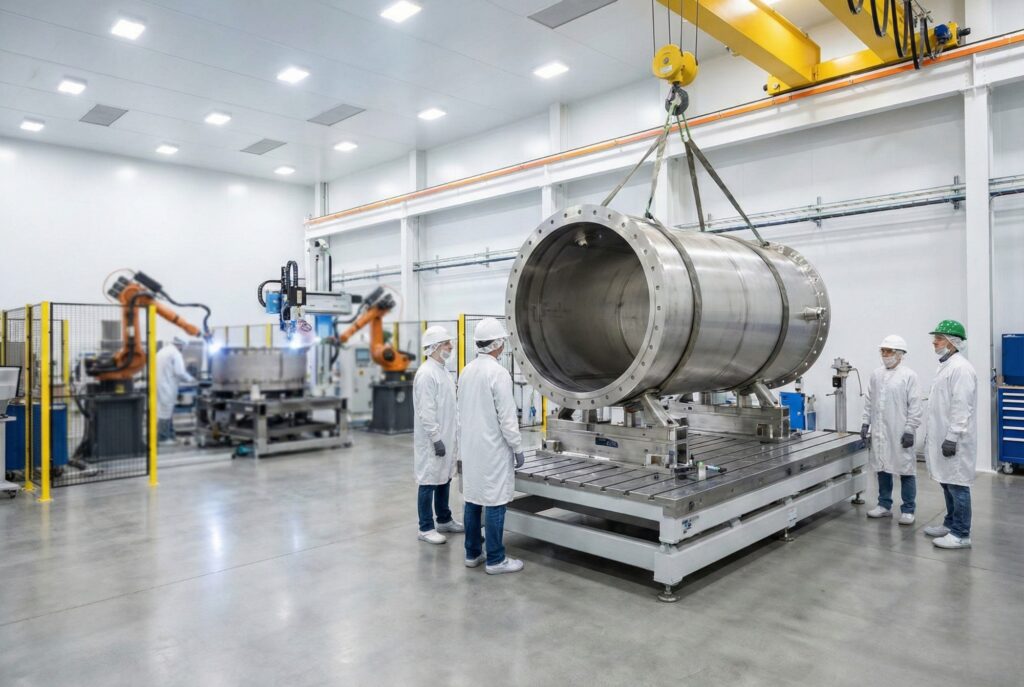
The industry is praying for Small Modular Reactors (SMRs) to succeed. Traditional nuclear plants are construction nightmares that take a decade to build. SMRs promise the “IKEA model”—factory-fabricated parts trucked to the site and assembled.
Comparison: Traditional Nuclear vs. SMRs
| Feature | Traditional Light Water Reactor (LWR) | Small Modular Reactor (SMR) |
|---|---|---|
| Output | 1,000 MW – 1,600 MW Gigawatt scale | 50 MW – 300 MW |
| Footprint | 1+ square mile buffer zone | Compact fits on <20 acres |
| Build Time | 7–10+ years Custom built on-site | 3–5 years target Factory assembled |
| Cooling | Massive water needs Rivers/Oceans | Minimal some use air/molten salt |
| Safety Zone | 10-mile emergency planning zone | Reduced potentially site-boundary limited |
| Capital Cost | High upfront $10B+ | Lower upfront scales via mass production |
Data: U.S. Department of Energy / World Nuclear Association.
Oracle and the Gigawatt Future
If you think Microsoft and Amazon are aggressive, look at Oracle. Chairman Larry Ellison recently told investors he wants a data center that consumes over one gigawatt of power.
That is not a building. That is a city.
Ellison plans to power it with a trio of SMRs. While the vendor remains unnamed, the intent is clear: data center planning has mutated. It is no longer about fiber optics and cooling aisles. It is now indistinguishable from utility-scale power plant engineering.
The Reality Check
Excitement is high, but friction is higher. The Nuclear Regulatory Commission (NRC) does not rush. Licensing a new reactor design—especially an unproven SMR—costs hundreds of millions and takes years before a shovel hits the dirt.
Then there is the fuel. Advanced SMRs often require HALEU (High-Assay Low-Enriched Uranium). Right now, the global supply chain for HALEU is dangerously thin, and historically dominated by Russia. Developing a domestic supply chain is non-negotiable.
The Path Forward
Big Tech is effectively becoming the new utility sector. They are vertically integrating energy generation to protect their core assets.
If SMR technology matures in the 2030s, the data center of the future won’t just be a warehouse connected to the grid. It will be an energy island—self-sufficient, nuclear-powered, and totally detached from the crumbling public infrastructure outside its walls.
