


It’s official: “Siri Pro” is locked to the iPhone 17. Apple confirmed the split this week, revealing that the engine behind Apple Intelligence 2.0 will leave the iPhone 16 Pro Max behind.
The reason isn’t arbitrary—it’s physics. Apple states the A19 chip’s Neural Engine is the absolute minimum requirement to run new “Reasoning” models locally. Earlier versions of Apple Intelligence cheated; they offloaded work to the cloud or used lightweight models. Siri Pro is different. It prioritizes privacy and speed by running on-device. That shift demands a specific hardware baseline: 12GB of RAM and 45 TOPS (Trillion Operations Per Second). The iPhone 17 Pro and Air have it. The iPhone 16 does not.
The Google Partnership: A Hard Pivot
The rumors were right. Apple and Google are partnering up. The initial Apple Intelligence rollout—built on proprietary Ajax models and a loose tie-in with OpenAI—is being sidelined. Version 2.0 runs on a custom-distilled version of Google’s Gemini Nano and Ultra.
This solves Siri’s oldest problem: memory. Siri Pro can finally hold a conversation. It can recall an email from three weeks ago, cross-reference it with a live Calendar event, and draft a relevant Message. But this “stateful” awareness is heavy. It requires memory bandwidth the A18 chip simply cannot sustain.
Why the A18 Pro Choked

iPhone 16 Pro owners are going to be loud about this, but the technical disparity is real. The A18 Pro was designed with an 8GB RAM ceiling. Engineering notes indicate the LLM powering Siri Pro permanently reserves 3.5GB of RAM.
Do the math. On an 8GB device, that leaves the operating system and background apps fighting for scraps. The user experience would degrade instantly. The A19 chip fixes this with a redesigned memory controller. It allows the Neural Engine to access system memory without waking the CPU, saving battery. The old architecture wasn’t built for this.
Specs Comparison: The Hardware Gap
To understand the exclusivity, look at the raw specifications. The gap between the 2024 and 2025 silicon isn’t about clock speed—it’s about AI capacity.
| Feature | iPhone 16 Pro (A18 Pro) | iPhone 17 Pro (A19 Pro) |
|---|---|---|
| RAM | 8GB LPDDR5X | 12GB LPDDR6 +50% |
| Neural Engine | 16-core (35 TOPS) | 32-core (50 TOPS) 2x cores |
| LLM Capacity | 3 Billion Parameters (Compressed) | 7 Billion Parameters (Native) 2.3x larger |
| Context Window | 8k Tokens | 128k Tokens 16x larger |
| Siri Processing | Hybrid (Cloud Dominant) | 80% On-Device Privacy boost |
The “Action Button” for Software
Siri Pro is no longer just a chatbot; it’s an agent. You can tell it, “Send the photos from last night’s dinner to everyone in the calendar invite,” and it executes. Siri opens Photos, identifies the images, checks the Calendar guest list, and drafts the Message. You don’t touch the screen.
This requires “screen awareness”—the AI constantly analyzing pixels to understand what you’re looking at. That process is computationally expensive. The iPhone 17’s A19 handles it with a dedicated low-power “Context Core” inside the NPU. Attempting this on an iPhone 16 would likely force the phone to throttle its performance within minutes.
The Thermal Reality
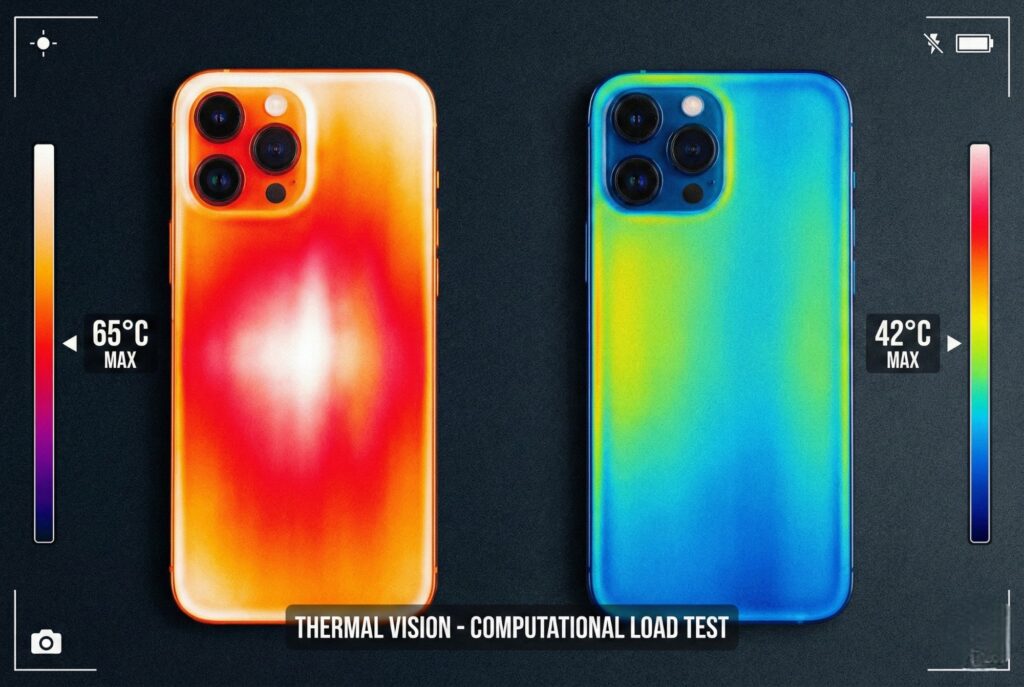
Heat is the factor nobody talks about. Continuous AI processing generates massive thermal output. The iPhone 17 manages this with a new graphite-sheet cooling system and a conductive aluminum substructure. It dissipates heat 40% more efficiently than the iPhone 16 Pro’s titanium shell. Apple’s internal testing reportedly showed that running Siri Pro on older hardware triggered thermal safety shutdowns. You can’t use an assistant if your phone is too hot to hold.
Navigating the Upgrade Cycle
Analysts see what’s happening. This is a manufactured “super-cycle.” Hardware innovation has plateaued, so software exclusivity is the new differentiator.
It’s a risky play. Alienating customers who bought a premium device less than 18 months ago damages trust. Apple argues that keeping features exclusive ensures reliability. Offloading these tasks to the cloud for older devices would contradict their strict privacy stance. “Private Cloud Compute” is for heavy lifting, not for every interaction.
Summary and Outlook
The launch of Apple Intelligence 2.0 marks a transition from passive assistants to active agents. By drawing a hard line at the iPhone 17, Apple is signaling that the AI era requires new hardware. It’s not about how fast the processor is anymore. It’s about memory, bandwidth, and thermodynamics. The iPhone 16 is still a great phone, but for Apple’s AI future, it’s already obsolete.
