

The trade war is off; the building boom is on. In a massive geopolitical maneuver finalized this week, the United States and Taiwan struck a trade agreement that trades cash for access. Amidst threats of crippling import duties under the Trump administration’s “America First” directive, Taiwan Semiconductor Manufacturing Co. (TSMC) and its peers pledged a staggering $250 billion in direct U.S. investments.
The return? Washington agreed to cap reciprocal tariffs on Taiwanese goods at 15% and carved out critical exemptions for semiconductor imports. This move effectively secures the supply chain for American giants like Apple and Nvidia, while accelerating the forced march of advanced chip manufacturing to the Arizona desert.
The deal, signed in mid-January 2026, follows months of volatility. The White House leveraged the threat of tariffs as high as 100% to force supply chain relocation. Under these new terms, TSMC dodges the steepest levies by committing to expand its Arizona footprint—growing from six planned facilities to potentially ten or more. This agreement alters the “Silicon Shield” dynamic—the theory that Taiwan’s manufacturing dominance guarantees its defense—by physically transferring that critical infrastructure to American soil.
The Diplomacy of Pressure

Pressure worked. The negotiations were driven by the aggressive enforcement of the International Emergency Economic Powers Act (IEEPA) and Section 232 investigations. Commerce Secretary Howard Lutnick was blunt: foreign chipmakers must build in America or face punitive duties that would make their products unsellable in the U.S. market.
For TSMC, the stakes were existential. The U.S. threatened a blanket 20–25% reciprocal tariff on Taiwanese imports—and up to 100% on companies refusing to localize. That would have destroyed margins. The resulting compromise offers a structured “safe harbor.” Taiwan’s tariff rate drops to 15%, but the real victory for the chip industry is the exemption linked to construction progress. You build, you escape the tax.
Terms of the Trade: Investment for Access
This deal doesn’t just promise future factories; it links current market access to construction milestones. The architecture is designed for speed.
The “import allowance” mechanism is the core of the agreement. Companies building fabs in the U.S. can import chips from Taiwan duty-free at a specific multiple of their U.S. capacity. During the construction phase, TSMC can import 2.5 times its planned U.S. output without tariffs. Once the factories go live, that allowance adjusts to 1.5 times the actual production capacity. This allows TSMC to keep serving clients like AMD and Broadcom from its Taiwan foundries while its Arizona plants struggle through yield ramping—provided they keep the cranes moving.
Comparative Analysis: The Deal vs. The Threat
The table below outlines the difference between the initial administrative threats and the finalized framework.
| Feature | The Administration’s Threat | The Finalized Deal |
|---|---|---|
| Reciprocal Tariff Rate | 20% – 25% (with threats up to 100%) | Capped at 15% |
| Semiconductor Exemption | None (full levies applied) | Yes, based on U.S. capacity (2.5x during build, 1.5x after) |
| Investment Requirement | Undefined “Reshoring” demand | $250 Billion direct investment + $250B credit guarantees |
| Target Outcome | Tariffs as revenue source | 40% of Taiwan’s semi supply chain moved to the U.S. |
| TSMC Arizona Scope | 2-3 Fabs (Initial plan) | (targeting 10+ facilities total) |
Redefining the “Silicon Shield”
For decades, the “Silicon Shield” theory argued that the world’s reliance on Taiwan’s fabs acted as a deterrent against geopolitical aggression. By compelling TSMC to move its most advanced processes—and significant volume—to North America, this deal dilutes that exclusivity.
Analysts view this as a necessary trade-off for Taiwan. It secures economic stability and avoids a trade war with its most important security partner. But it also “insures” the U.S. against a blockade of the Taiwan Strait. By 2030, the U.S. wants a self-sustaining ecosystem for advanced logic chips. If Taiwan’s production goes offline, the global impact would no longer be total catastrophe.
Operational Realities in Arizona
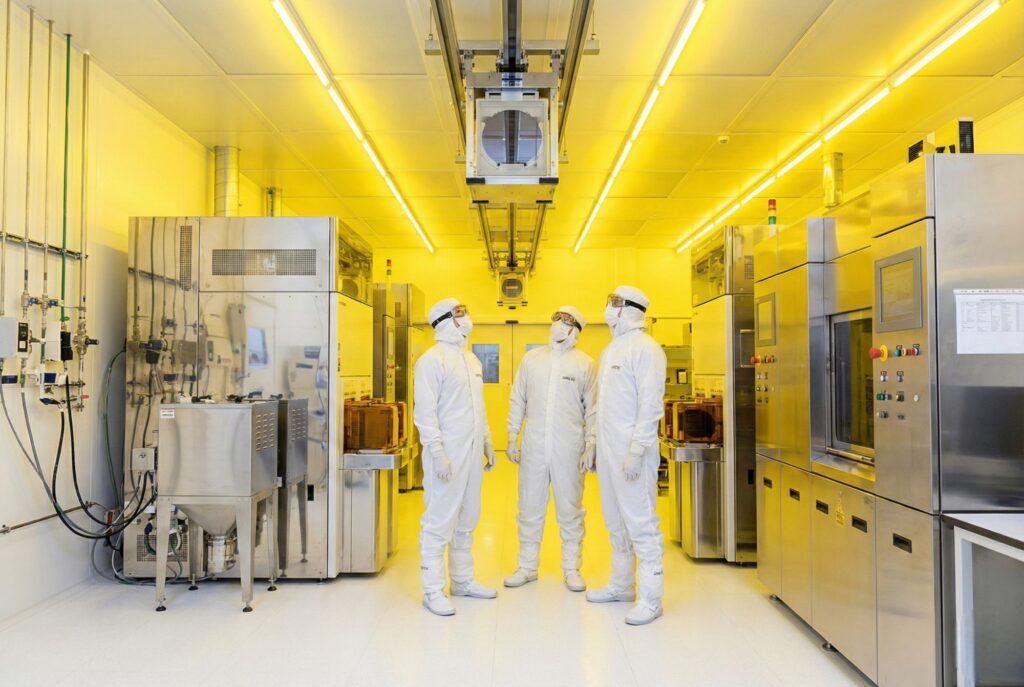
Signing the paper is the easy part. TSMC’s Arizona project has historically faced friction—labor disputes, cultural clashes in management, and operational costs that dwarf those in Hsinchu.
To hit the deal’s ambitious $250 billion target, the U.S. supply chain must evolve fast. This involves not just the fabs, but the complex web of chemical suppliers, maintenance firms, and packaging facilities that usually cluster in East Asia. The massive credit guarantees provided by the Taiwanese government are intended to help smaller suppliers follow TSMC across the Pacific. They aren’t just building a factory; they are transplanting an entire industrial ecosystem to the Sonoran Desert.
The Forward Look
This agreement kills the era of borderless semiconductor supply chains. “Sovereign silicon” has arrived. For U.S. consumers and tech companies, the deal likely prevents immediate price spikes on electronics. But the long game relies on execution. If TSMC slips in Arizona, their duty-free import allowances could vanish, reigniting trade tensions overnight.
The focus now shifts to the desert floor of Phoenix. The “Silicon Shield” is no longer just a metaphorical defense for an island nation; it is becoming a tangible, concrete fortress on American soil.
