
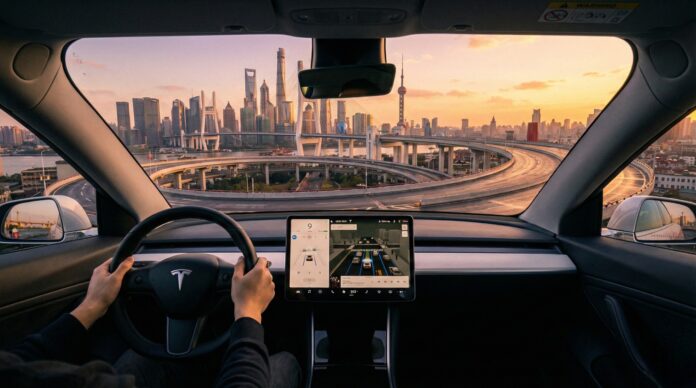
SHANGHAI — The wait is over—sort of. The Chinese Ministry of Transport (MOT) greenlit a “Limited Pilot” for Tesla’s Full Self-Driving (FSD) software early Tuesday, handing the U.S. automaker a critical win in its most important overseas market. Starting February 1, 2026, a specific slice of Tesla’s fleet can finally engage FSD on public roads in Shanghai and Hangzhou.
This isn’t just a permit. It’s a precedent. No foreign automaker has ever been allowed to run advanced autonomous systems on Chinese city streets without a local minder in the driver’s seat. Tesla pulled it off by surviving a brutal data security audit by the Ministry of Industry and Information Technology (MIIT) late last year. The verdict? Tesla’s data stays in China.
Drivers must remain supervised—hands on the wheel, eyes up. But the approval signals a crack in the regulatory ice that has frozen Tesla out of the “smart driving” race while domestic rivals like Huawei and Xpeng flooded the streets with their own systems.
The “Limited” Pilot: What It Means
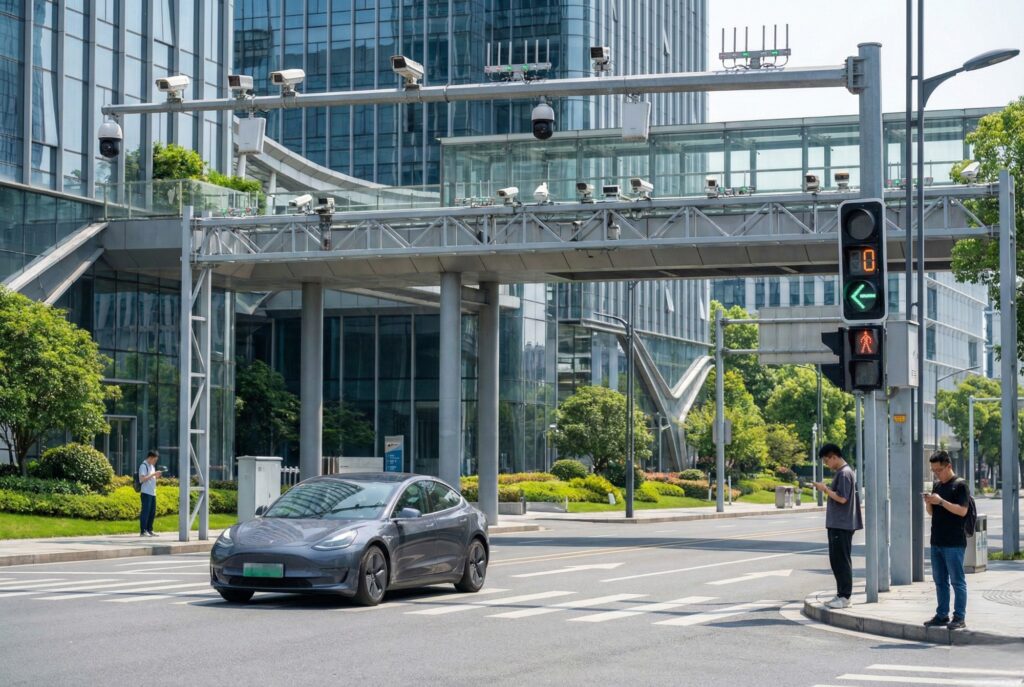
Don’t expect a nationwide rollout. The MOT is keeping the leash tight. Unlike the open beta strategy utilized in North America, this pilot is fenced in. Literally.
- Location: Confined to Shanghai’s Lingang Special Area—Tesla’s manufacturing backyard—and specific high-tech corridors in Hangzhou.
- Volume: Five thousand cars. That’s it. Owners need a safety score of 98 or higher to even apply.
- Infrastructure: It’s not just about cameras. Vehicles must communicate with local V2X (Vehicle-to-Everything) grids, a strict requirement of the Chinese rulebook.
“This isn’t opening the floodgates; it’s a stress test,” says Zhang Wei, senior analyst at the Beijing Auto Policy Institute. “The Ministry isn’t just testing the car. They are testing Tesla’s discipline regarding mapping laws under real-world pressure.”
Navigating the Data Security Hurdle
Security concerns—specifically foreign entities filming sensitive locations—kept FSD grounded for years. Tesla found a workaround: a partnership with Baidu for lane-level mapping and a local data center in Shanghai.
The “Limited Pilot” proves regulators are finally buying the hybrid solution. Tesla’s cameras drive the car; Baidu’s maps keep it legal.
Tesla vs. The Local Giants: A Tech Standoff
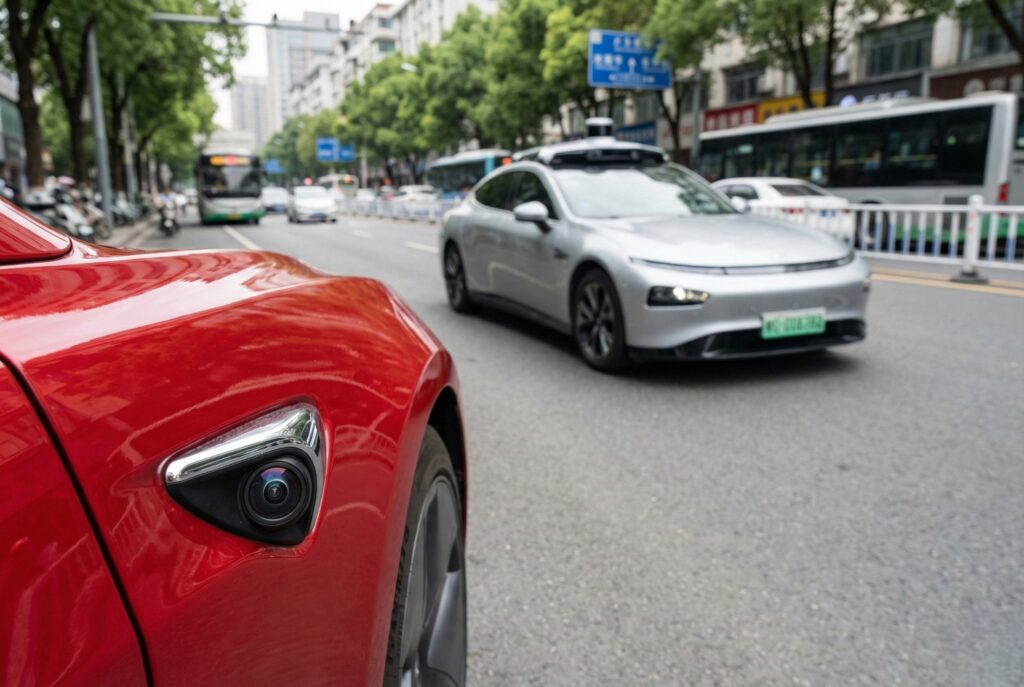
While Tesla sat in regulatory limbo, domestic rivals didn’t blink. Xpeng (XNGP) and Huawei (ADS 3.0) pushed their systems to market, covering major cities often without needing high-definition maps at all.
Now, it’s a showdown. Pure vision versus LiDAR.
FSD vs. Chinese Competitors
| Feature | Tesla FSD (Limited Pilot) | Huawei ADS 3.0 | Xpeng XNGP |
|---|---|---|---|
| Sensor Suite | Pure Vision (Cameras only) | LiDAR + Cameras + Radar | LiDAR + Cameras + Radar |
| Mapping Tech | Standard Maps + Real-time Vision | Roadmap-less (GOD Network) | Light Map / Map-less |
| Coverage | Shanghai/Hangzhou (Geo-fenced) | Nationwide (Urban + Highway) | Nationwide (Urban + Highway) |
| Cost | 64,000 RMB (One-time) | ~30,000 RMB (or included) | Included (Max/Pro trims) |
| Processor | Tesla HW3/HW4 | Huawei MDC | NVIDIA Orin-X |
The Market Implications
The timing matters. Tesla is fighting a brutal price war. Domestic brands are digital-first; for a Chinese buyer, “smart driving” isn’t a bonus feature. It’s the baseline.
Unlocking FSD allows Tesla to monetize the hardware already sitting in driveways. Even a conservative 10% subscription rate would inject hundreds of millions into revenue. But at 64,000 RMB ($9,000 USD), it’s a tough sell. Xpeng basically gives the tech away for free on sub-$30,000 cars.
The “Catfish” Effect
The MOT might be playing a strategic game here. Call it the “catfish effect.” In 2019, the Shanghai Gigafactory forced the local supply chain to grow up. FSD might do the same for software.
“If FSD works in Lingang, the pressure on Baidu and Huawei to refine their algorithms skyrockets,” notes Li Min, a tech columnist for Caixin Global. “It forces the industry from ‘good enough’ to ‘exceptional’.”
A Measured Step Forward
Musk got his win, but the victory lap is premature. Expansion hinges entirely on the crash data. One high-profile accident, one data leak, and the program goes dark.
For now, eyes are on Shanghai. The question isn’t whether Tesla can drive in China. It’s whether it can outdrive the locals who have owned the road in its absence.
