

A staggering 69% of all Google queries now end without a single click to an external website. Between early 2025 and the first quarter of 2026, independent tech publishers worldwide faced a brutal reality—a 33% collapse in organic search referrals. To survive, they are tearing down old revenue models.
This traffic cratering isn’t a glitch. It is the direct result of generative engines like Google’s AI Overviews, Perplexity, and OpenAI’s ChatGPT. These platforms intercept users, synthesizing reviews and troubleshooting guides right on the results page. The traditional search algorithm is dying; in its place, publishers are pivoting to direct audience engagement, proprietary data, and Generative Engine Optimization (GEO).
The Mechanics of the Traffic Crash
For twenty years, tech media survived on a simple transaction. A user searched for a laptop review. They clicked a link. The publisher monetized that visit via display ads or affiliate links.
That transaction is broken. Large Language Models (LLMs) now scrape, summarize, and serve that exact information instantly.
Ask an engine how to fix a Windows registry error. The AI spits out the answer block. No click required. Publishers still supply the raw intelligence, but they get zero traffic. Zero ad impressions. Zero affiliate revenue.
Quantifying the Damage
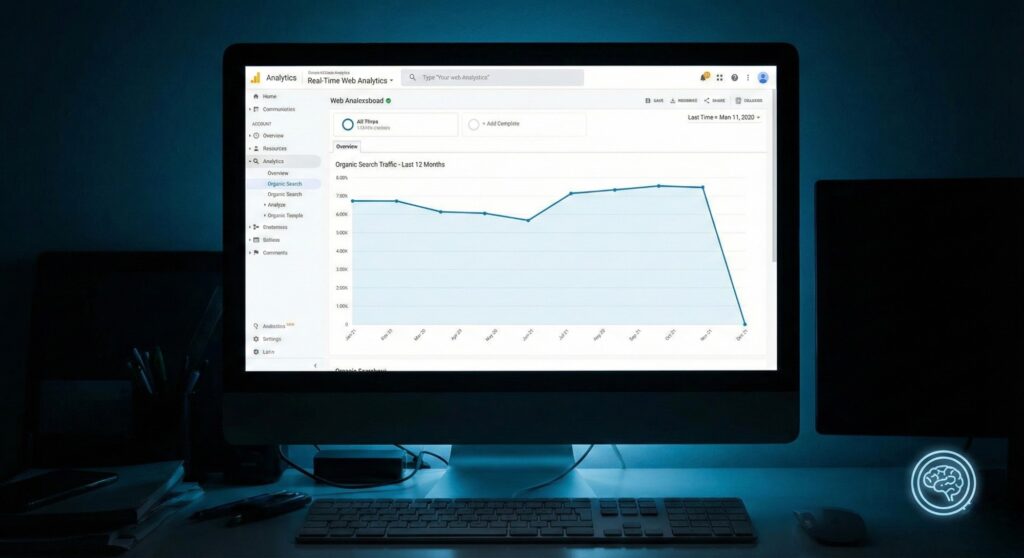
Industry data from late 2025 paints a grim picture. AI summaries shove organic links into the basement of the results page.
When an AI block appears, the click-through rate for standard links plummets to 8%. Without the AI block, those same links capture about 15% of the clicks.
| Search & Traffic Metric | 2024 Baseline | 2026 Reality | Impact on Publishers |
|---|---|---|---|
| Zero-Click Search Rate | 58% | 69% | Top-of-funnel casual traffic wiped out. |
| Global Search Referrals | Baseline | Down 33% | Ad revenue models severely crippled. |
| Queries Triggering AI | ~6% | ~21% | Near-invisibility for basic informational queries. |
| AI Referral Conversion | N/A | 14.2% | Low volume, but extremely high user intent. |
📉 Publisher Crisis: The shift from traditional search to AI-powered overviews represents an existential threat to content publishers. While AI referral conversion is strong, the dramatic 33% drop in overall referral traffic fundamentally undermines advertising-based business models.
Moving Beyond the Search Algorithm
Waiting for search engines to fix the traffic leak is a fool’s errand. They won’t.
Instead, independent sites are abandoning the pageview rat race. The new currency isn’t raw traffic—it’s direct audience capture.
The Pivot to Direct Audiences
Email newsletters and gated communities are now survival mechanisms. When you move content to an inbox, you bypass the algorithm entirely.
Publishers are locking their highest-value work behind subscription walls. Deep-dive benchmarks. Exclusive teardowns. Tailored buying advice. They cultivate private communities on Discord or Telegram, building a loyal readership that AI simply cannot scrape.
Structuring for Generative Engines
Old-school SEO meant chasing keywords. The new frontier is Generative Engine Optimization (GEO).
GEO forces AI systems to cite your original work. Publishers achieve this by stripping down their site architecture. They use pristine JSON-LD markup and semantic HTML. This feeds clean, machine-readable data—specs, scores, pros and cons—directly to the LLM. If the AI understands the data structure, it cites the source.
The Conversion Paradox: Quality Over Quantity
Here is the strange twist in the AI era. Traffic is down, but the visitors who do click through are incredibly valuable.
Data shows that AI-referred users convert at massive rates. A visitor arriving via an AI summary converts at 14.2%. Standard organic search? Just 2.8%.
Adapting Content Formats

Why the high conversion? Trust. Users read the AI summary, but they click the link because they need human verification.
Generic listicles are dead. AI writes those for free. Survival requires original testing, bespoke datasets, and hands-on video.
An LLM cannot benchmark a GPU’s thermal throttling. It cannot tell you how a mechanical switch feels. Human-driven data forces the AI to use you as the primary source.
The Authority Signal
Video—especially YouTube—resists the zero-click drain. AI cannot synthesize the visual proof of a product demonstration.
Furthermore, brand authority is a hard metric. Generative engines prioritize recognized, heavily cited brands. Independent sites must push for digital PR, podcast spots, and cross-platform mentions. You have to be talked about to be cited.
The Next Era of Digital Publishing
The integration of AI into search dismantled the web’s old economy. Sites churning out high-volume, low-effort fluff are already dying off.
But a leaner, more resilient model is taking shape. By investing in proprietary research, structured data, and direct subscriptions, independent publishers are making themselves algorithm-proof. The goal is no longer ranking first on a search page. It’s becoming the definitive human authority that machines are forced to quote.
