
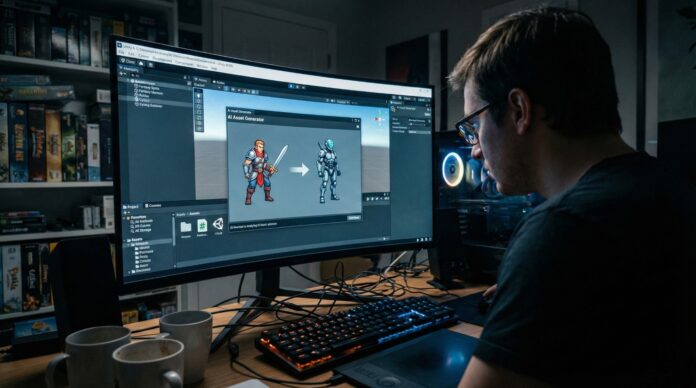
Unity Technologies is officially sunsetting Muse. In its place comes the integrated “Unity AI” suite, rolling out in the Unity 6.2 beta through 2026. Developers are already calling it the “Gen-Asset” update. Why? It bakes the “Generators” toolset directly into the Editor toolbar. No more context switching. Just prompt, generate, and deploy sprites, textures, and animations natively.
For solo developers, this begs a massive question. Can this pipeline finally handle high-volume mobile game reskinning? Buying Unity templates to swap out visual assets and rush a publish to the Google Play or Apple App Store is a time-tested strategy. Retain the C# codebase; change the paint job. But reducing production cycles isn’t just about speed. It’s about navigating copyright landmines, rationing the new Unity Points economy, and maintaining actual structural fidelity.
Moving from Muse to Integrated Generators
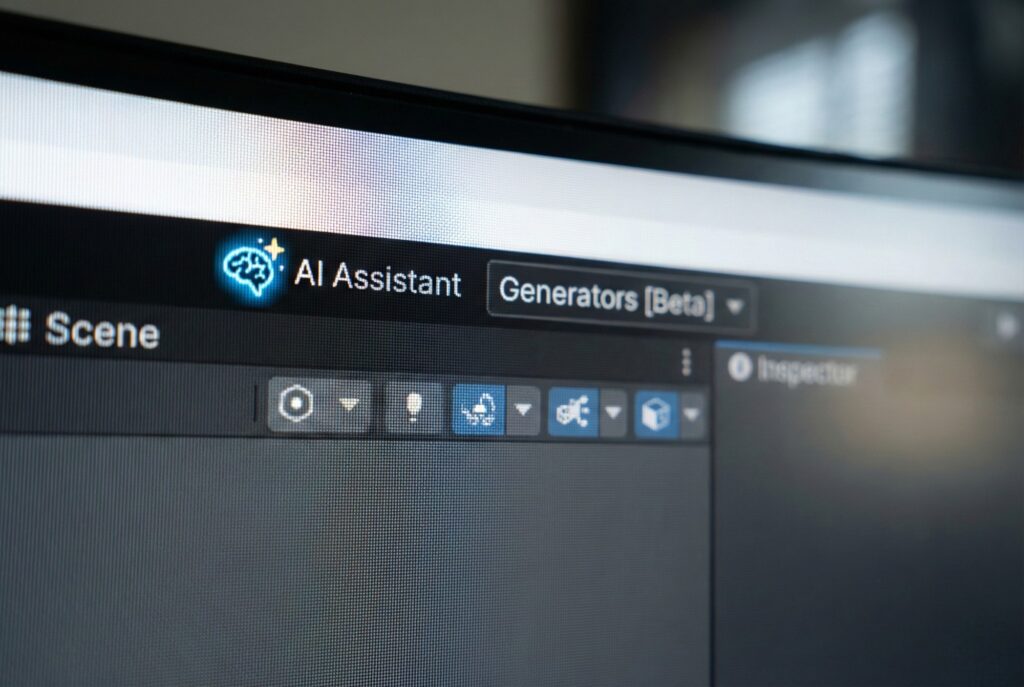
The leap from a standalone Muse subscription to the native Unity AI ecosystem alters the daily grind. Forget the external dashboard. Developers now access the Assistant, Generators, and Inference Engine through a persistent AI button in the workspace. It cuts out the tedious export-import dance entirely.
Need a stylized 2D platformer character? Prompt the system. The Generator spits out the sprite—already formatted for your active rendering pipeline. Behind the curtain, this runs on proprietary data mixed with Azure OpenAI Services (GPT) and Meta’s Llama.
The Economics of Unity Points
General availability of Unity 6.2 brings a hard pivot in monetization. The flat-rate Muse subscription is dead. Welcome to Unity Points.
These points come bundled into standard Unity Pro, Enterprise, and Industry plans. For a solo dev operating on a shoestring budget, calculating the cost-per-asset is now a survival skill. Run out of points? You buy more bundles. Mismanage your generation requests, and those cost overruns will bleed a project dry.
| Feature Category | Previous Architecture (Muse) | New Architecture (Unity 6.2 AI) | Expected Availability |
|---|---|---|---|
| Conversational Assistance | Muse Chat | Assistant (GPT & Llama models) | Beta available now |
| Visual Asset Creation | Muse Sprite, Texture, Animate | Generators (Integrated directly) | General Availability in 2026 |
| Local Model Processing | Unity Sentis | Inference Engine | Beta available now |
| Pricing Structure | Standalone Monthly Subscription | Unity Points (Included in Pro/Enterprise) | General Availability in 2026 |
Local Processing with the Inference Engine
Cloud generation is just half the story. The update officially buries the Sentis framework, replacing it with the Inference Engine. This lets you run AI models locally—either right in the Editor or on end-user devices at runtime.
It doesn’t ship with built-in models. Instead, you import pre-trained structures from open repositories. Why does this matter? It’s a loophole. Run models locally, and you bypass spending Unity Points on cloud compute. It also paves the way for dynamic, on-device generation while the game is actually running.
Mechanics of Mobile Game Reskinning
Reskinning is surgical. You extract visual and audio assets, plug in new ones, and pray the core mechanical logic holds. Unity Generators attack this bottleneck by processing natural language prompts alongside reference images.
Feed the system a baseline 2D asset. Ask for five variations in different art styles.
The AI outputs usable sprites, explicitly formatted to hit your dimensional constraints. A/B testing thematic shifts—like flipping a sci-fi UI into a medieval fantasy layout—now takes hours, not weeks.
Targeting UI and Environmental Textures
Right now, UI elements and static environmental textures are the prime targets for automation. Generating a brushed metal button or a seamless cobblestone floor is structurally simple. Animating a bipedal character? Not so much.
You can churn out entire libraries of UI panels, icons, and background plates using the Texture Generator. Better yet, these static pieces usually drop straight into the existing project hierarchy with zero friction. For a solo dev chasing rapid iteration, this is where the ROI lives.
Data Transparency and Metadata Tracking
Shipping generated content commercially requires a paper trail. Unity knows this. Consequently, all generated assets and scripts now pack embedded EXIF metadata. The files themselves declare their AI origins.
This isn’t just trivia. It lets you filter project directories instantly, isolating AI files from human-authored work. If you use the built-in Project Auditor, this transparency is a lifesaver for quality assurance.
Copyright and App Store Guardrails
Automated generation is a legal minefield. Case in point: mid-2025. A Unity employee live-streaming a demo accidentally generated imagery of a copyrighted Disney character. It was a glaring exposure of system-side blind spots. Unity’s response? The responsibility for dodging copyright infringement rests entirely on your shoulders.
If you use these tools for commercial releases, audit everything. Both the Apple App Store and Google Play enforce strict AI disclosure and anti-plagiarism rules. Upload a sprite that looks a little too familiar, and you face immediate app removal—or a permanent account ban.
Can the Process Be Fully Automated?

Unity leadership recently hinted at a future where users can prompt entire games into existence. We aren’t there yet. In the 6.2 production environment, fully automating a reskin is a pipe dream.
The AI acts as a digital assembly line for raw materials—backgrounds, textures, static props.
But implementation demands a human touch. Animations still need precise rigging corrections. Sprite sheets require accurate slicing and collider mapping. The workflow is undeniably faster. But it’s an accelerant, not an autopilot.
The shift to Unity AI and the integrated Generators cuts serious fat from the asset production timeline. You no longer have to manually paint every texture variant. But it replaces that labor with a new headache: managing the Unity Points economy. As the toolset hits general availability in late 2026, it will stand as a potent iteration engine. Just remember—manual curation isn’t optional if you actually want to ship a functional, commercial product.
