

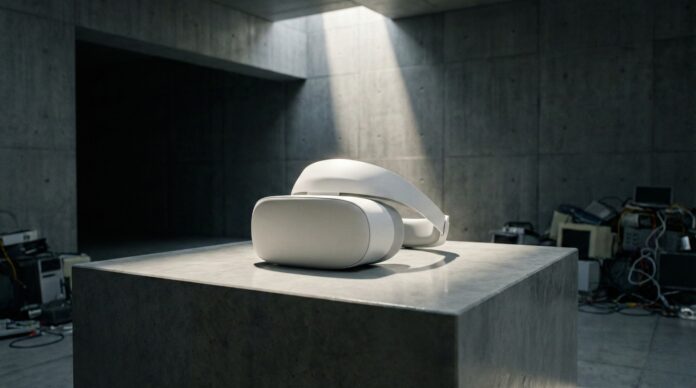
Meta’s hardware roadmap just got a lot smaller. Following the cancellation of the premium “La Jolla” headset project and a brutal 20 percent budget cut to Reality Labs, the unannounced Meta Quest 4 is no longer just another project. It is the only project that matters.
Supply chain sources now point to a tightened release window of late 2026. But the “La Jolla” kill-order does more than change the date—it enforces a strict price ceiling. Meta isn’t chasing Apple’s Vision Pro anymore. Instead, the Quest 4 will pivot to mass-market accessibility, prioritizing AI integration over raw optical horsepower. The goal is simple: stop the bleeding and hold the entry-level throne.
The “Only Child” Strategy
Killing “La Jolla”—originally slated for 2027—cleared the deck. Previously, engineering talent was fractured across the affordable Quest line, the experimental Pro models, and various AR prototypes. The recent layoffs, which cut approximately 1,500 roles, specifically targeted those peripheral teams.
Now, the Quest 4 is the “only child” of the VR division. It won’t have to fight for resources; it inherits the tech that survives the budget cuts.
Industry insiders suggest this consolidation will accelerate the development cycle. Meta cannot afford a “gap year” with zero hardware revenue while the Quest 3 gathers dust. A reveal at the Connect conference in September or October 2026 is the likely target.
Pricing: The Sub-$600 Hard Ceiling
The death of “La Jolla” offers the clearest signal yet regarding Meta’s pricing philosophy. The project was killed because the projected unit cost pushed the retail price past $1,000—a number CEO Mark Zuckerberg now views as a commercial cliff for consumer VR.
That sets a hard limit. The Quest 4 will almost certainly adhere to the sub-$600 structure established by its predecessors. Meta is done subsidizing massive hardware losses, meaning we are looking at distinct trade-offs to keep the sticker price at $499.
The Bifurcation Theory
To keep enthusiasts happy without breaking the bank, rumors suggest a split strategy:
- Standard Quest 4 ($499): The direct successor to the Quest 3, focusing on mixed reality and gaming.
- Quest 4 “Plus” ($699-$799): A tier that adds eye-tracking and increased storage but stays well clear of four digits. It replaces the failed Pro line—without the “Pro” baggage.
Specs Analysis: The AI Pivot
The marketing is changing. It’s less “Metaverse Portal,” more “Spatial AI Computer.” The device’s architecture will reflect this shift.
The Silicon Upgrade

Under the hood, look for the Qualcomm Snapdragon XR2 Gen 3. While the Gen 2 chip in the Quest 3 offered a massive leap in graphics, the Gen 3 will focus on neural processing units (NPU).
This is critical. A robust NPU allows the headset to run Large Language Models (LLMs) locally. This cuts latency for Meta AI, enabling real-time object recognition and translation without constantly pinging a cloud server.
The Controller-Free Gamble
Here is the risk. To keep that $499 tag while upgrading the silicon, Meta has to cut somewhere. Reports suggest they might ship the Quest 4 without controllers.
It’s a “hands-first” bet. By relying on the significantly improved computer vision of the new chipset, Meta could ditch the expensive Touch Plus controllers to drop the entry price to $399—or redirect that budget toward better displays. Controllers would become optional accessories, signaling a shift toward general computing and media consumption rather than just gaming.
Comparative Specifications
The following table projects the likely specifications of the Quest 4 based on current supply chain constraints and the recent strategic pivot.
| Feature | Meta Quest 3 (Current) | Meta Quest 4 (Predicted) |
|---|---|---|
| Release Date | October 2023 | Late 2026 |
| Launch Price | $499 (128GB) | $499 (Standard) / $799 (Premium) |
| Processor | Snapdragon XR2 Gen 2 | Snapdragon XR2 Gen 3 (AI Focus) |
| RAM | 8 GB | 12 GB – 16 GB |
| Eye Tracking | No | Likely (Premium SKU only) |
| Display Type | LCD + Pancake Lenses | Mini-LED or High-Dynamic LCD |
| Controllers | Touch Plus (Included) | Optional / Sold Separately (Rumored) |
| Primary Focus | Mixed Reality / Gaming | Spatial AI / General Computing |
Why Micro-OLED is Off the Table
If you were waiting for an Apple Vision Pro rival with 4K Micro-OLEDs, stop waiting. The “La Jolla” cancellation confirms Meta won’t pay the premium.
Those panels cost manufacturers upwards of $350 per pair. Including them would instantly blow the mass-market budget. Instead, expect the Quest 4 to utilize advanced Mini-LED technology with local dimming. It offers better contrast than standard LCDs without the prohibitive cost of OLED.
Assessing the Impact
This is a sobering moment for VR, but a necessary discipline for Meta. The “throw everything at the wall” era is dead.
For the buyer, the Quest 4 becomes a focused product, not an experiment. It won’t try to do everything; it will try to be the best mixed-reality computer you can actually afford. By killing its high-end dreams, Meta ensures the core product survives the winter.
