
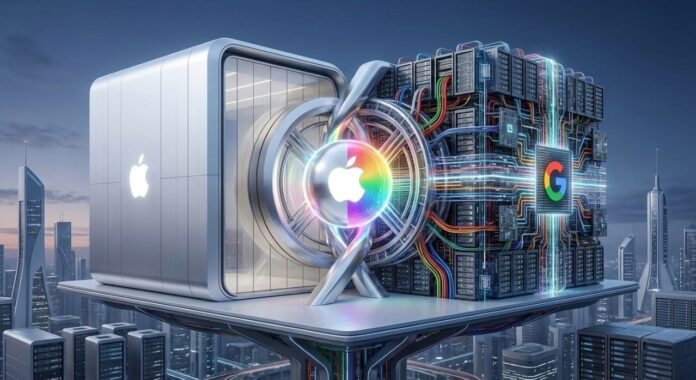
Apple and Google shook hands on a define-the-decade deal Monday, January 12. The objective is singular: save Siri.
In a joint announcement that ends months of speculation, the tech giants confirmed a multi-year partnership to embed Google’s Gemini models directly into the iPhone. This isn’t a simple search deal. Google is now the architectural lead for the next generation of Apple’s voice assistant. Analysts peg the contract at roughly $1 billion annually—a high price to pay to stop Siri from losing more ground to OpenAI’s ChatGPT.
The overhaul targets the iOS 19 release cycle, hitting public devices later in 2026.
The “Foundational” Shift
This is a hard pivot from Apple’s previous strategy. In the past, third-party chatbots were allowed to sit next to Siri—optional tools for specific questions. That era is over. Gemini will now serve as the bedrock for the new “Apple Foundation Models.”
The statement from Cupertino was blunt. Apple chose Gemini after testing the field, labeling it the “most capable foundation” for the job. It is a humbling admission. Apple’s internal teams could not match the velocity of Google’s DeepMind division. Rather than ship an inferior product, Apple bought the best engine on the market.
For Google, the win is massive. Gemini instantly lands on 2 billion active Apple devices, securing a dominance that Microsoft and OpenAI can’t touch.
Privacy in the Age of Outsourced AI
The engineering challenge here is obvious: How do you merge Google’s data-hungry algorithms with Apple’s privacy-obsessed marketing?
The answer lies in a split brain. Apple constructed a bifurcated architecture to keep Google at arm’s length. Lightweight tasks stay on the phone, processed by a distilled “Nano” version of Gemini running on Apple’s neural chips. The heavy lifting—complex queries needing massive compute—goes to Apple’s “Private Cloud Compute” (PCC).
Apple insists the firewall is absolute. The Gemini models in the cloud are “frozen.” They provide the reasoning logic, but they don’t learn from you, and Google sees nothing. No persistent profiles. No ad targeting. It is Google’s brain, but it’s living in Apple’s house.

Siri 2.0: Context is King
Siri has been a glorified kitchen timer since 2011. The Gemini injection aims to finally make it a “contextual agent.”
The new Siri gains “on-screen awareness.” It can see what you are looking at. More importantly, it uses “App Intents” to chain actions together. You could ask Siri to “find that contract photo I got yesterday and email it to the guy I just texted.”
Old Siri would have Googled the word “contract.” The new Siri understands time (“yesterday”), visual content (the photo), and social context (“the guy I just texted”). It’s a leap from command-response to actual reasoning.
| Feature | Current Siri (iOS 18) | Next-Gen Siri (Gemini Powered) |
|---|---|---|
| Context Window | Resets after every command. | Remembers context across apps and sessions. |
| Visual Awareness | Blind to screen content. | Reads and analyzes text/images on screen. |
| Reasoning | Fails at multi-step logic. | Handles “Chain-of-thought” problem solving. |
| App Integration | Rigid, pre-programmed shortcuts. | Universal “App Intents” for cross-app actions. |
| Processing | Hybrid (On-device/Standard Cloud). | Hybrid (On-device/Private Cloud Compute). |
The OpenAI Question
Where does this leave Sam Altman? In 2024, Apple brought ChatGPT in as a flashy “overflow” handler for Siri.
That integration survives, but it has been demoted. Apple’s decision to build its core infrastructure on Gemini relegates OpenAI to a niche utility for specific “world knowledge” queries. It signals a preference for stability. Google’s infrastructure is a known quantity; OpenAI’s governance has been too volatile for Apple’s risk-averse culture.
Market Reaction and Timeline
Wall Street didn’t hesitate. Alphabet (GOOGL) shares spiked, briefly pushing the company’s valuation past $4 trillion and overtaking Apple in intraday trading. Investors see the billion-dollar price tag as validation—Google’s massive capital spending on AI is finally converting into unavoidable infrastructure.
Developers will get their hands on the new Siri at WWDC in June 2026. The rest of the world has to wait until the iPhone 18 launch in September.
Summary
Apple is done trying to go it alone. By renting Gemini, they secure a state-of-the-art engine immediately, buying time to refine their own silicon. For the user, the promise is simple: a voice assistant that actually works. The industry is now watching to see if two of tech’s fiercest rivals can successfully co-exist inside the same operating system without tearing each other apart.
