
For three years, the “universal” smart home has felt less like a futuristic convenience and more like a part-time IT job. The promise was simple: buy a device, plug it in, and control it with whatever phone or speaker you have at hand. The reality was a headache of “No Response” errors, conflicting networks, and pairing codes that worked only when they felt like it. But with the release of the Matter 1.4 specification in November 2024, the Connectivity Standards Alliance (CSA) has finally stopped trying to sell us new features and started fixing the plumbing.
This update isn’t about flashy new gadgets. It is a fundamental repair of the underlying infrastructure. By standardizing Home Routers and Access Points (HRAP) and forcing Thread Border Routers to actually talk to each other, Matter 1.4 addresses the fragmentation that turned early adoption into a nightmare. The smart home isn’t dead. It just needed a reboot.
The “Broken” Years: Why 1.0 Stalled
To see why 1.4 matters, you have to look at the mess of versions 1.0 through 1.3.
The initial rollout suffered from the “Multi-Admin” feature—a great idea on paper that was miserable in practice. Pairing a light bulb to Apple Home and then adding it to Google Home meant digging through sub-menus to generate pairing codes. It was tedious. It was technical. It failed constantly.
Then there was the “Thread Border Router War.” Thread is the low-power mesh protocol designed to connect sensors without a massive hub. But early on, companies didn’t play nice. An Apple HomePod, a Google Nest Hub, and an Amazon Echo in the same room would often create three separate, isolated Thread networks. Instead of one strong mesh, you had three weak islands. Data couldn’t route efficiently. Latency spiked. Devices dropped offline. It was a mess.
The Fix: Routers Finally Get Smart

Matter 1.4 introduces a hardware category that solves the island problem: Home Routers and Access Points (HRAP).
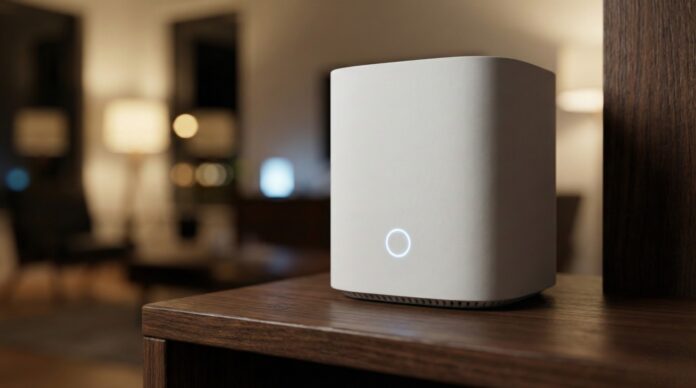
Before this, your Wi-Fi router was just a spectator. It moved data but didn’t understand the smart home network. Under 1.4, certified routers from brands like Eero or Ubiquiti become the central nervous system. They combine a Wi-Fi Access Point and a Thread Border Router into one certified box.
Here is the real fix: Matter 1.4 mandates a standardized, secure directory for Thread network credentials. No more hoarding keys.
When you add a new Thread Border Router—whether it’s inside a router or a smart speaker—it automatically grabs the existing credentials and joins the primary mesh. It stops competing and starts contributing. This creates a single, dense mesh that covers the entire house. Range increases. Reliability stabilizes. The network finally works as a team.
Enhanced Multi-Admin: One and Done
The friction of living in a mixed-device household—iPhone in the pocket, Samsung tablet on the couch—is finally being sanded down.
Matter 1.4 introduces “Enhanced Multi-Admin” with single user consent. You don’t need to manually pair a device to every single platform anymore. You grant permission once. The device then handles the handshake, negotiating keys and access with other authorized ecosystems in the background. The 11-digit pairing code fatigue is over.
Comparison: Matter 1.3 vs. Matter 1.4
Matter 1.3 was about filling the kitchen with compatible appliances. Matter 1.4 is about keeping the lights on and the data moving.
| Feature Category | Matter 1.3 May 2024 | Matter 1.4 Nov 2024 |
|---|---|---|
| Primary Focus | Appliances & Water Management | Infrastructure & Energy Intelligence |
| New Device Types | Microwaves, Ovens, Dryers | Heat Pumps, Solar Panels, Battery Storage |
| Network Stability | Standard error handling | HRAP Certified Routers & Access Points |
| Thread Handling | Basic Border Router support | Unified Mesh Mandatory credential sharing |
| Multi-Admin | Manual pairing codes | Single Consent Automated ecosystem linking |
| Power Efficiency | Basic energy reporting | LIT Long Idle Time Years of battery life |
The Energy Play: Heat Pumps and VPPs
Beyond fixing the bugs, Matter 1.4 positions the smart home as a grid asset. The update adds support for heavy hitters: heat pumps, solar arrays, and battery storage.
This isn’t just on/off control. The specification allows these devices to broadcast their load capabilities. It enables a “Virtual Power Plant” (VPP) setup. A home can automatically dim lights, throttle the heat pump, and discharge a battery to the grid when electricity prices spike.
Previously, doing this required expensive proprietary hubs and custom installer work. Now, a solar inverter from one brand can talk directly to a thermostat from another. They optimize usage based on real-time grid data, and the user doesn’t have to lift a finger.
Stability: Letting Devices Sleep
A quiet but massive improvement in 1.4 is “Long Idle Time” (LIT).
Smart home sensors—door contacts, leak detectors—run on tiny coin cell batteries. In previous versions, the network required them to “check in” constantly to prove they were alive. That drained batteries fast.
Matter 1.4 changes the rules. It adjusts the protocols, allowing these sensors to sleep for much longer periods without being marked as “offline.” We are talking about extending battery life from months to years. It reduces the maintenance chore and stops devices from disappearing from your app just because they were saving power.
The Road Ahead
The narrative that the smart home is “broken” came from a gap between marketing noise and engineering reality. Matter 1.0 was a handshake; Matter 1.4 is the signed contract. By standardizing the router hardware and automating the messy credential exchange, the CSA has removed the biggest technical roadblocks.
But remember: a specification is not a product.
There is always a lag—usually 6 to 9 months—between the PDF release and the hardware on the shelf. The blueprints are finished, but the factories are just getting started. Expect to see the first wave of Matter 1.4 routers and energy devices land in mid-to-late 2025. The smart home is fixed—we’re just waiting for the update to download.
